
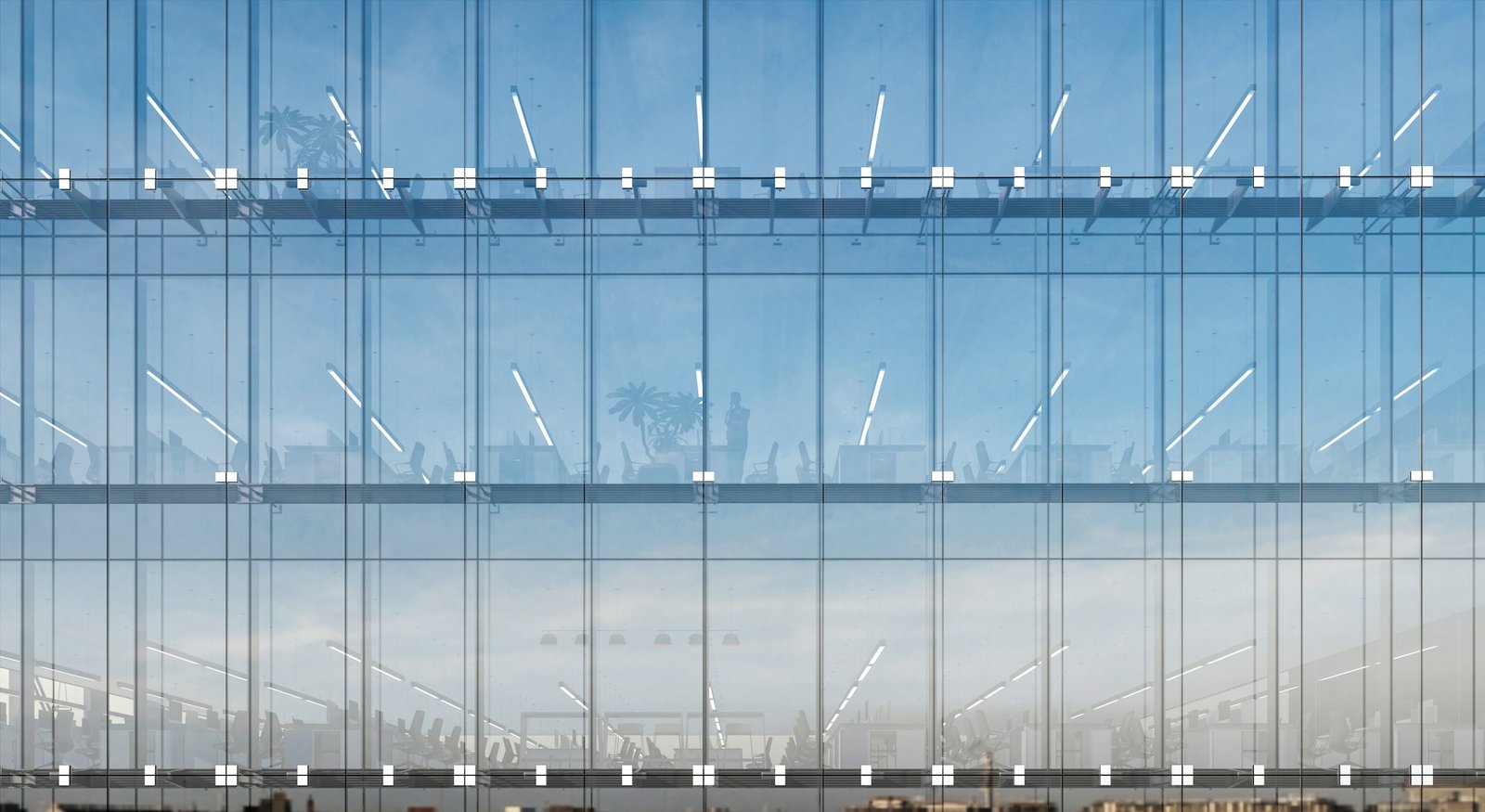
Look up at almost any modern building in Dubai and you’ll see it. Floor-to-ceiling glass wrapping around towers in Downtown Dubai, aluminium and glass facades climbing high-rises in Business Bay, sleek curtain wall systems reflecting the skyline across DIFC and Jumeirah Lake Towers. Curtain wall systems are one of the defining visual features of Dubai’s built environment, and for very good reason.
But curtain wall systems aren’t just about looks. They’re a sophisticated building envelope solution that controls how a building manages heat, light, weather, and energy. In a city with Dubai’s climate, that performance dimension is every bit as important as the aesthetic one.
Whether you’re an architect, a developer, a contractor, or a building owner trying to understand your options, this guide covers everything you need to know about curtain wall systems in Dubai. The types available, how they work, what they cost, how installation works, and how to choose the right system for your specific project.
At Glass World Industries, curtain wall systems are one of our core specialities across Dubai and the UAE. We’ve worked on commercial towers, hotel facades, mixed-use developments, and institutional buildings, and we bring that real-world experience to every conversation we have about curtain wall projects.
What Is a Curtain Wall System?
Before getting into types and costs, it’s worth being clear about what a curtain wall system actually is, because the term is sometimes used loosely in the construction industry.
A curtain wall is a non-structural outer wall system attached to the building’s structural frame. Unlike a traditional load-bearing wall, a curtain wall carries no structural load from the building itself. Its job is to enclose the building, manage the interface between inside and outside, resist wind loads and weather, control thermal performance, and in most cases, provide the visual facade of the building.
The curtain wall Dubai hangs from or is attached to the building’s primary structure, typically the floor slabs or columns, and transfers wind and other lateral loads back to that structure. This is fundamentally different from a structural wall that carries the weight of the building above it.
In Dubai, curtain wall systems are used across a huge range of building types. Commercial office towers, luxury hotels, residential high-rises, hospitals, airports, shopping centres, and mixed-use developments all use curtain wall systems to varying degrees. The combination of large glass areas, slim aluminium profiles, and the ability to create seamless floor-to-ceiling facades makes curtain wall the dominant choice for modern construction across the UAE.
Types of Curtain Wall Systems in Dubai
There is no single curtain wall system that suits every building and every project. Understanding the main types helps you identify which approach is right for your specific situation.
Stick Curtain Wall Systems
Stick curtain wall is the most widely used curtain wall system across Dubai’s construction industry, and it gets its name from the way it’s assembled. The system is built up on-site piece by piece, with individual aluminium mullions, the vertical members, and transoms, the horizontal members, assembled one stick at a time on the face of the building.
The glass or other infill panels are then inserted into the aluminium framework and sealed in place. The entire system is assembled and glazed from outside the building, typically using scaffolding or building maintenance units.
Stick curtain wall is popular in Dubai for several reasons. It’s flexible, allowing the design to be adjusted relatively easily during construction. It requires less factory prefabrication than unitised systems, which can be an advantage when lead times are tight. And it’s generally more cost-accessible than unitised alternatives, which makes it attractive for mid-range commercial and residential projects.
The main consideration with stick systems is that they are more dependent on site workmanship quality than unitised systems. The sealing and assembly happens on site in Dubai’s often harsh construction conditions, which means quality control and supervision are important.
Read also: Curtain Wall Systems Explained
Unitised Curtain Wall Systems
Unitised curtain wall systems take a completely different approach. Instead of assembling the system piece by piece on site, unitised systems are manufactured in panels in a factory. Each panel, typically spanning one floor height and one structural bay width, arrives on site complete with glass already glazed into the aluminium frame, ready to be hoisted and connected to the building structure.
The panels interlock with each other using a system of male and female joints that create the weather seals as the panels are installed. Once a panel is hoisted into position and secured to the floor slab bracket, the next panel is interlocked alongside it, and the process continues around the building.
Unitised systems are the preferred choice for Dubai’s tallest and most demanding commercial towers. The factory-controlled manufacturing environment ensures consistent quality across every panel, which is difficult to replicate at the scale and pace of a major high-rise construction project.
They also offer faster installation on site because the panels arrive ready to install, which matters enormously on large-scale projects with tight programme schedules.
The trade-off is cost and lead time. Unitised systems require significant investment in factory tooling and setup, and the lead time for manufacturing is longer than for stick systems. For large projects in Dubai where quality consistency and installation speed are priorities, this investment is typically well justified.
Semi-Unitised Curtain Wall Systems
Semi-unitised systems sit between stick and fully unitised approaches. Some components are prefabricated in the factory while others are assembled on site. This hybrid approach allows projects to benefit from some of the quality and efficiency advantages of unitisation while managing cost and lead time more carefully.
In Dubai’s market, semi-unitised systems are used on projects where a fully stick system would struggle to meet the quality or programme requirements but a fully unitised system isn’t justified by the project scale or budget.
Structural Glazing Curtain Wall Systems
Structural glazing curtain wall systems use silicone adhesive bonding to attach the glass panels to the aluminium frame rather than mechanical pressure plates and caps. The result is a flush, uninterrupted glass facade with no visible external fixings, which gives a particularly clean and seamless appearance.
Dubai has some of the most impressive structural glazing facades in the world. The technology allows buildings to present an almost mirror-like glass surface that reflects the sky and surrounding cityscape. It’s a visually striking system that has become strongly associated with premium commercial and hospitality architecture in the UAE.
Structural glazing requires careful design, high-quality silicone systems, and precise quality control during manufacturing and installation. The long-term performance of the silicone bonds is critical, and this is an area where choosing an experienced and reputable curtain wall supplier in Dubai is particularly important.
Point-Fixed Glass Curtain Wall Systems
Point-fixed curtain wall systems attach glass panels to the supporting structure using discrete stainless steel fittings at specific points on the glass, typically at the corners of each panel. The glass panels are drilled and fitted with special spider fittings or patch fittings that connect to a steel or aluminium support structure behind.
The result is a glass facade with minimal visible support structure, giving an impression of glass that is almost floating in space. Point-fixed systems are used for dramatic architectural statements, entrance canopies, atria, and feature facades in Dubai’s hotels, retail centres, and corporate headquarters.
Read also: Architectural Glass: A Complete Guide to Curtain Walls and Structural Glazing in UAE
Aluminium Curtain Wall Systems
Aluminium curtain wall is the dominant framing material for curtain wall systems in Dubai, and it’s worth understanding specifically why aluminium is so well suited to this application.
Aluminium is lightweight, which reduces the load transferred back to the building structure. It’s strong enough to span floor-to-floor heights and resist wind loads. It can be extruded into highly precise profiles with complex cross-sections that incorporate thermal breaks, drainage channels, and gasket seats in a single piece.
It doesn’t rust or corrode in Dubai’s coastal and humid conditions. And it can be powder-coated or anodised in a virtually unlimited range of colours and finishes to meet any architectural requirement.
The thermal break in a modern aluminium curtain wall profile is particularly important in Dubai’s climate. The thermal break is a non-conductive material inserted into the aluminium profile that interrupts the thermal conductivity of the metal, reducing heat transfer between the hot exterior and the cooled interior.
In a city where air conditioning accounts for a significant proportion of building energy consumption, the thermal performance of the curtain wall system has a direct impact on operating costs over the building’s lifetime.
Glass Options for Curtain Wall Systems in Dubai
The glass specified for a curtain wall system has an enormous impact on both the performance and the appearance of the building facade. In Dubai’s climate, glass selection is a critical engineering and architectural decision.
High-performance solar control glass is the most important consideration for Dubai curtain wall projects. Uncontrolled solar gain through a glass facade in Dubai’s summer heat would make interior spaces unbearably hot and place enormous demands on air conditioning systems.
Solar control glass uses coatings, typically applied through a magnetron sputtering process, to reflect or absorb a proportion of solar radiation before it enters the building, dramatically reducing solar heat gain while still allowing visible light transmission.
Double glazed units, also known as insulating glass units, are standard in Dubai curtain wall systems. Two glass panes are separated by a sealed air or gas-filled cavity that provides thermal insulation. The combination of solar control coatings on the outer pane and the insulating cavity significantly improves the overall thermal performance of the curtain wall.
Low-emissivity coatings further improve thermal performance by reflecting infrared radiation back into the building during cooler periods and reducing heat transmission from outside during hotter periods. In a climate like Dubai’s, where both summer cooling loads and winter heating are relevant, low-E coatings contribute meaningfully to year-round energy efficiency.
Laminated glass is used in curtain wall applications where safety from glass fallout is a concern, particularly for overhead glazing, glass that is accessible to the public, and applications where the consequences of glass breakage falling from height are a primary safety consideration.
Curtain Wall Costs in Dubai: What to Expect
Curtain wall system costs in Dubai vary significantly depending on the type of system, the glass specification, the scale of the project, the complexity of the design, and the performance requirements involved.
Stick curtain wall systems sit at the more accessible end of the pricing range for curtain wall in Dubai. The lower factory prefabrication requirement and simpler supply chain make them more cost-accessible for mid-scale commercial and residential projects.
Unitised curtain wall systems command a premium over stick systems because of the factory manufacturing investment, the higher material and engineering content of each panel, and the specialist installation equipment required. For large-scale high-rise projects in Dubai, the speed and quality benefits of unitisation typically justify this premium in the overall project economics.
High-performance glass specifications including solar control double glazed units, low-E coatings, and laminated outer panes add to the material cost of the curtain wall but deliver ongoing energy savings over the building’s operational life that frequently outweigh the upfront investment.
Structural glazing and point-fixed systems are priced at the premium end of the curtain wall market, reflecting the engineering precision, material quality, and installation expertise required.
The most accurate way to understand the cost of a curtain wall system for your specific project in Dubai is to engage with an experienced curtain wall specialist early in the design process. At Glass World Industries, we work with project teams from the early design stages to help optimise the system selection, performance specification, and cost plan for each project.
Read also: Benefits of Curtain Walls in Dubai
Curtain Wall Installation in Dubai: How the Process Works
Understanding the installation process helps project teams plan effectively and manage the curtain wall package within the overall construction programme.
For stick curtain wall systems, installation begins with the setting out of anchor brackets on the building structure. The aluminium mullions are then installed vertically, connected to the brackets and adjusted for alignment. Transoms are fixed between the mullions to complete the aluminium grid. Glass panels are then glazed into the system from outside, with pressure plates, caps, and silicone seals completing the weatherproofing.
For unitised systems, installation begins with the fixing of support brackets to the floor slabs at each level. Completed panels are then hoisted floor by floor using the building’s tower crane or dedicated hoisting equipment. Each panel is manoeuvred into position and connected to the floor slab brackets, with adjacent panels interlocking to create the continuous weather seal. The speed of installation for unitised systems on large Dubai towers can be remarkable, with experienced teams installing multiple floors of panels per week.
Waterproofing and air infiltration testing are important quality assurance steps for curtain wall installation in Dubai. The UAE’s occasional intense rain events, combined with high wind pressures at elevation, mean that the weather performance of the curtain wall system needs to be verified. Mock-up testing before full installation and periodic site testing during installation are standard practice on quality-conscious curtain wall projects in Dubai.
Glass World Industries: Curtain Wall Specialists in Dubai
At Glass World Industries, we bring genuine expertise and hands-on experience to curtain wall projects across Dubai and the wider UAE. From initial system selection and specification through to fabrication, supply, and installation, we manage the curtain wall package with the thoroughness and attention to detail that major building projects demand.
We work with architects, developers, main contractors, and building owners across Dubai’s commercial, hospitality, residential, and institutional sectors. Every project is different, and we approach each one with fresh eyes and a commitment to getting the right outcome for the specific building, site, and programme.
Contact Glass World Industries today to discuss your curtain wall project in Dubai. Let’s start with a conversation about what your building needs and how we can deliver it.